This monument is in the village of Kopčany in south-west Slovakia, near the border with the Czech Republic. It commemorates the Russian soldiers who died during the liberation of the village from the Nazis on April 10, 1945. It lists the name, rank and date of birth of each soldier, and at the bottom it also mentions nine more soldiers who could not be identified because they were not carrying papers. It is unusual to find such a monument in Slovakia which is only written in Russian, usually the captions are written in both Russian and Slovak. The most interesting part of the inscription is the line at the bottom, which reads "Sleep peacefully in brotherly ground". Therefore the brotherly Slavic relations between Russians and Slovaks were called upon to show that the Russian soldiers were not buried there in foreign soil, but died in the cause helping a fellow Slavic, socialist country.
This monument is in the small rural village of Nová Lehota in western Slovakia. It is dedicated to the Slovak partisan soldiers who fought the Nazis in 1944 as part of the Slovak National Uprising. The red star affixed to the top makes it clear that the soldiers were fighting for the establishment of communism in Slovakia, though this was not entirely the case. Some partisans were connected to communist organizations, but certainly not all of them. The communist leaders of Czechoslovakia sought to portray the Slovak partisans as fighting solely for the reunification of Czechoslovakia in a socialist state and any issue of Slovak independence aspirations or political systems other than communism were not represented publicly.
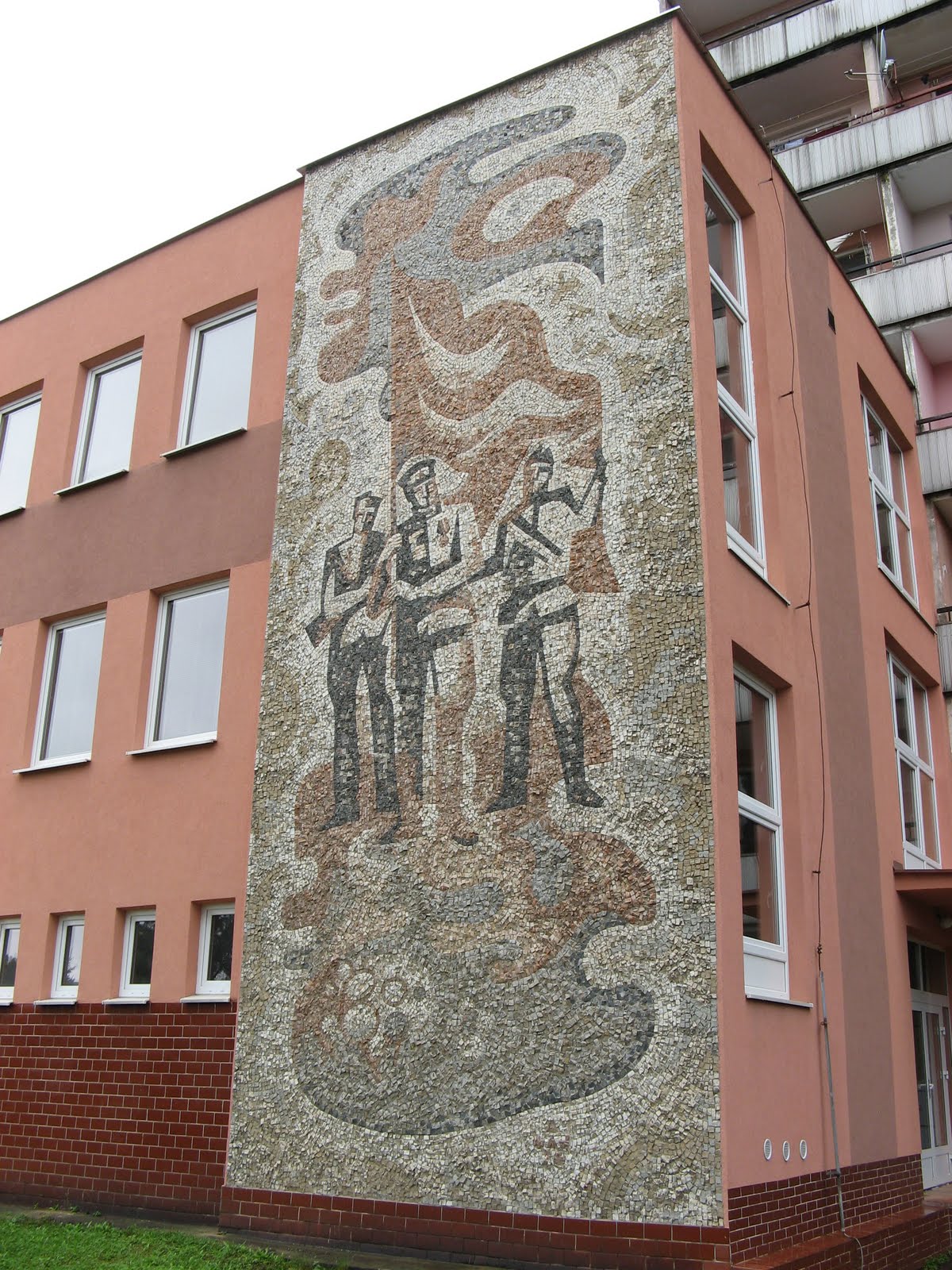
This wall mosaic is on the side of a building in the centre of Svidník, a town in north-east Slovakia. It shows three soldiers carrying the red flag of socialism who are ready to defend Czechoslovakia, or perhaps they are meant to commemorate the Russian and Czechoslovak forces who helped to liberate the town from the Nazis at the end of the Second World War. Fierce battles were fought to reclaim Svidník, and most of the town was completely destroyed in the fighting. Therefore the appearance of Svidník today is dominated by structures from the socialist period, in other words it's a sea of grey concrete. Several other murals adorn the walls of the city, mostly with a military theme.
These murals can be seen in the main hall of the train station in Kolín. They depict a bucolic scene of agricultural labourers in the countryside, clearly working together on a collective farm. The mural on the right also shows miners resting outside a mine shaft. Such pastoral images of labour are still common in many parts of the Czech Republic, since they contain few direct references to communism that would warrant their removal. Sometimes such murals have been altered to remove any visible Soviet/socialist symbols or references.
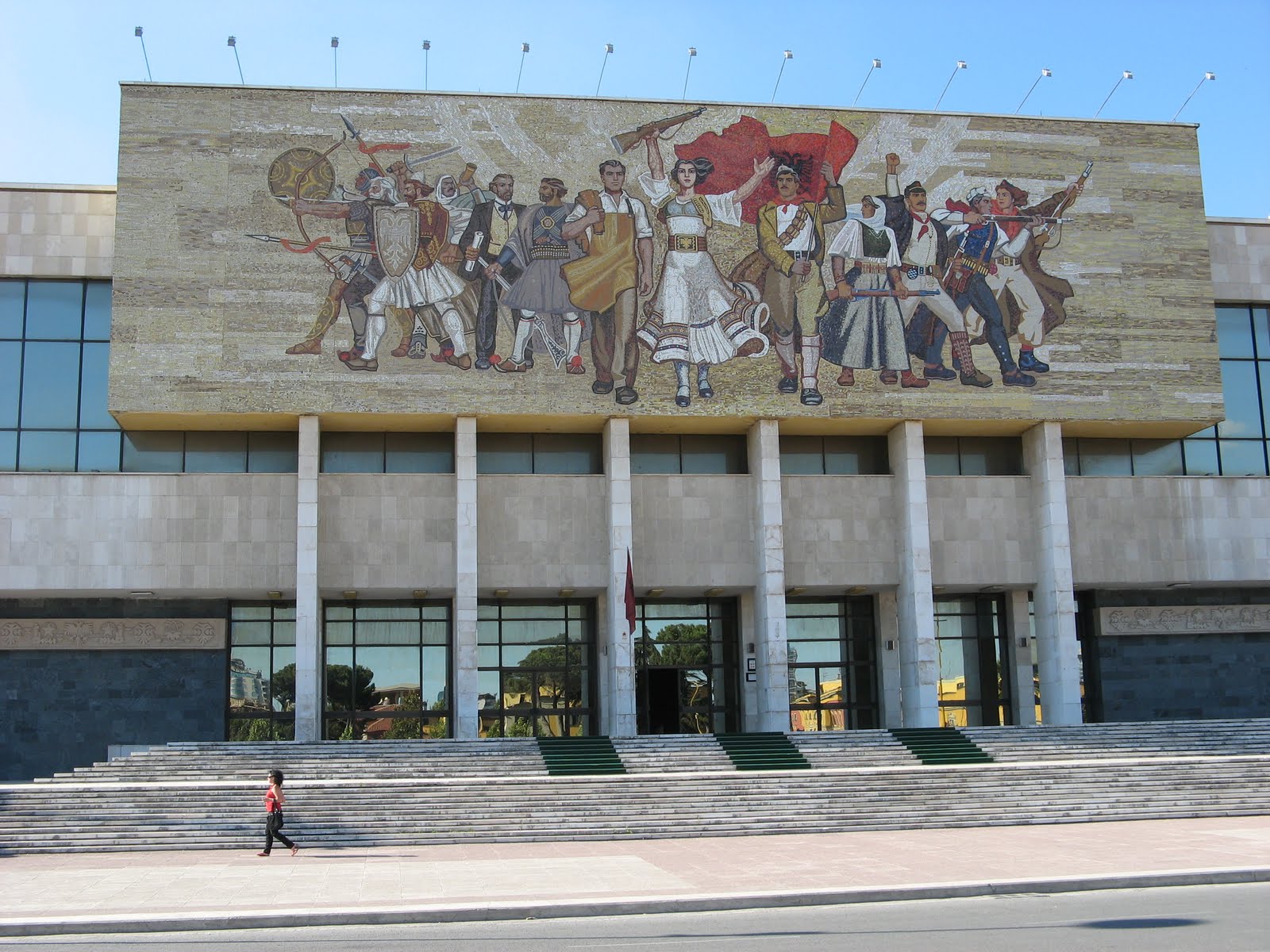
This mural is found above the entrance to the National History Museum of Albania in the capital, Tirana. It dominates the city's central square, making it one of the most recognizable images of Tirana. The mural portrays proud and strong Albanians defending the territory of their country against foreign invaders during every period of the nation's history, including the ancient Illyrians, the resistance to Turkish rule led by Skanderbeg, the partisan fighters of World War Two and the communist era under Enver Hoxha. The only change that has been made since the end of the communist period is that a red star has been removed from the flag. The museum itself is equally fascinating and makes a great introduction to the complexities of Albanian history. A number of important artifacts were looted during the 1990's, but there is still an impressive collection of exhibits on display.
The fight for the Dukla pass on the border between Slovakia and Poland was a major battle of the Eastern Front in the Second World War. German resistance was stonger than anticipated, and the advance of the Russian and Czechoslovak forces was held up for many months with over 70,000 casualties on both sides. Following the end of the war and the establishment of a communist government in Czechoslovakia in 1948, it was decided that the liberation of the country by the Red Army should be commemorated with the greatest possible fanfare. Cities and towns across the country erected statues and monuments to the Russian liberators, usually inscribed with the date that the settlement was freed from German forces. The Dukla pass was particularly important as the spearhead of the advance into Czechoslovak territory, and hence an enormous monument was erected there to honour the bravery of both Russian and Czechoslovak troops. A valley near the pass which saw intense fighting during the conflict became known as the "valley of death", and many abandoned military vehicles and tanks remained there following the battle. Many Russian tanks in the valley were restored to their original condition and then returned to the position where they had been found in the valley, some sitting frozen in the middle of advancing through a farmer's cornfield, others appearing to emerge from the forest to press the German defenses. Around a dozen Russian tanks remain spread through the fields and forests in the region today as memorials to the Russian liberators. At the peak of the Dukla pass on the Slovak-Polish border sits a lookout tower intended to allow visitors to view the full extent of the battlefield area. The nearby town of Svidník was almost totally destroyed in the battle, and today another large war memorial to the Soviet troops is a dominant feature of the town's layout.
The Dukla pass is easily reached by one of several daily buses to and from Svidník; Svidník is most easily reached by bus connection from Prešov or Bardejov. In Svidník, the Hotel Rubin is an inexpensive and reasonably comfortable place to stay.
In the Royal Garden next to Prague Castle, not far from the Royal Summer Residence, you will find the Royal Ball Game Hall. This building dates from the 16th century and was used by the king's courtiers for sporting activities. The structure was damaged by fire in May 1945 during the last stages of World War Two, but it was fully rebuilt in the 1950's. Along with the many mythological deities that were carefully restored on the facade, a small addition was made that remains as a quirky reminder of the communist period. A figure unfurling a scroll meant to be a five-year plan with a hammer and sickle was included in the design, together with the letters 'ČSR', for Czechoslovak Socialist Republic. This is a detail that you have to look closely to find (it's along the top row of the facade near the roof), so be sure to stop and take a closer look if you are visiting Prague Castle.